How to find out what note you’re singing
- Press Start listening and allow microphone access.
- Take a breath and sing a comfortable note on an open vowel such as “ah”, “oh” or “oo”.
- Hold it for a second. The big letter shows which note you’re singing, and the small number shows which octave.
- Watch the needle: left of center means flat (too low), right means sharp (too high). The pitch curve below the readout shows how your note moves over time.
- Choose a target note, press Play reference, and try to sing it back until the feedback turns green.
For example, if the detector reads A3, +12 cents sharp, you’re singing an A just below middle C, very slightly high. If it reads F♯4, −30 cents, you’re noticeably flat of F♯ above middle C and should lift the pitch a little.
How the vocal note detector works
Your singing voice is a pitched sound: your vocal folds vibrate at a steady rate, the fundamental frequency, and create harmonics above it. This voice note finder records nothing. It reads short slices of the microphone signal through the browser’s Web Audio API and runs a pitch detection algorithm (the McLeod Pitch Method) dozens of times per second. Detecting pitch this way means finding how often your waveform repeats, which gives the frequency in hertz.
The tool then maps it to the nearest note on the equal-tempered scale, using A4 = 440 Hz as the reference (adjustable in the settings), and works out the leftover difference in cents. A reading of “15 cents sharp” means you’re 15% of a semitone above that note. Noisy, high-frequency sounds such as “s”, “sh” and breath have no steady pitch, so the note detector ignores them instead of guessing.
Because it’s browser-based, it works the same on a laptop or a phone with no app to install. It uses the same engine as our online pitch detector (also called a pitch finder), which is better for instruments. This page adds a target note, a reference tone and singing-specific feedback, and is tuned for voices. Whether you’re singing or playing, instrumentalists who just want a chromatic tuner can use either one.
Understanding the note names
Western music uses 12 notes per octave: C, C♯/D♭, D, D♯/E♭, E, F, F♯/G♭, G, G♯/A♭, A, A♯/B♭ and B. After B the pattern repeats one octave higher. The number after the letter tells you which repetition you’re in. Middle C is C4, near the middle of the piano and a comfortable note for most adult voices.
That’s why two people can sing “the same note” and sound different: a typical male voice singing a melody sits about one octave lower than a female voice singing it, for example C3 instead of C4. Same note name, different octave and half the frequency.
If you learned music with Do Re Mi, switch the note names to solfège in the settings. In fixed-do, Do is always C, Re is D, Mi is E, and so on.
Singing in tune: how close is close enough?
Pitch accuracy is measured in cents, with 100 cents to a semitone. On a held note, most listeners won’t notice an error under 10 cents. Practice tip: first aim to land within ±25 cents (the green zone in pitch-matching practice), then work on staying within ±10 cents for the whole length of the note.
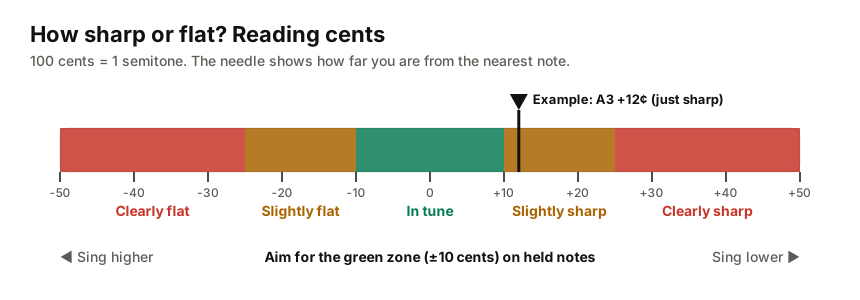
Common intonation problems the pitch graph will reveal:
- Scooping: starting below the note and sliding up. The line curves up at the start of each note.
- Going flat on long notes: often caused by running out of breath support. The line sags at the end.
- Pushing sharp on high or loud notes: extra tension raises pitch. The line overshoots.
- Wide or uneven vibrato: a healthy vibrato is a regular wave about 5–7 times per second, usually within about ±50 cents.
Typical vocal ranges by voice type
Your vocal range is the span from the lowest to the highest note you can sing, and your voice type is about where your voice sits most comfortably (your tessitura) and its color. The ranges below are typical for trained classical singers; untrained and pop voices vary widely, and it’s normal to fall between categories.
| Voice type | Typical range | Frequency | Character |
|---|---|---|---|
| Soprano | C4 – C6 | 262 – 1047 Hz | Bright, high female or treble voice |
| Mezzo-soprano | A3 – A5 | 220 – 880 Hz | Middle female voice, warmer than soprano |
| Alto (contralto) | F3 – F5 | 175 – 698 Hz | Lowest female voice, rich and dark |
| Tenor | C3 – C5 | 131 – 523 Hz | Highest common male voice |
| Baritone | A2 – A4 | 110 – 440 Hz | Most common male voice |
| Bass | E2 – E4 | 82 – 330 Hz | Lowest male voice |
To get a rough reading of your own range, use the Lowest note and Highest note boxes above. Warm up first, then slide slowly down to the lowest note you can produce clearly (not a croak), then up to your highest clear note. Count only notes you can sustain. For a guided version with a voice type result, take our vocal range test.
Why the note jumps around
Vibrato
Vibrato is a natural, regular wobble in pitch. The detector follows it, so the note may flicker between neighbors if your vibrato is wide. Focus on the center of the wave on the graph.
Register breaks
Moving between chest voice and head voice (the passaggio) can cause a sudden jump or crack. Seeing exactly which note it happens on helps you practice smoothing it out.
Overtones and octave errors
Every sung note contains harmonics at 2×, 3× and 4× the fundamental. If one of them is much louder than the fundamental, which happens with very low or very bright voices, the detector may briefly show the note an octave too high. Singing a darker “oh” vowel or moving closer to the mic usually fixes it.
Breathiness and background noise
Air noise has no pitch. A breathy or whispered tone gives the detector less to lock onto. Close windows, turn off fans and lower the mic sensitivity if a noisy room causes false readings.
Exercises to improve your pitch
These short ear training drills use the detector as instant feedback. Five minutes a day is enough to hear a real difference in a few weeks.
- Single-note matching: choose a target in the middle of your range, play the reference, sing it back and hold it for five seconds in the green zone.
- Sirens: glide smoothly from low to high and back on “oo”. Look for a continuous line with no gaps or jumps.
- Five-note scales: sing Do-Re-Mi-Fa-Sol-Fa-Mi-Re-Do and check that each step lands cleanly on the next note.
- Long tones: hold a single note as long as you can and watch the “Longest hold” timer. Keep the line flat right to the end.
- Intervals: sing a note, then jump a fifth or an octave and see how close you land without sliding.
Frequently asked questions
How can I tell what note I'm singing?
Press Start listening, allow the microphone and sing a steady vowel. The tool shows the note name with its octave (for example G3), the frequency in hertz and whether you are sharp or flat. Without a tool, you can match your note against a piano or a reference tone until they sound the same.
Why does the note keep changing while I hold it?
Small changes are normal: vibrato makes pitch wave by 20–100 cents, and breath support affects stability. If the display jumps by a whole octave, your voice probably has a strong overtone; sing a little louder, closer to the mic, on an open “ah” vowel.
Do men and women sing the same notes?
They can sing the same note names, but usually in different octaves. When a man and a woman sing “the same” melody together, the man is typically an octave lower, for example C3 instead of C4.
How close to the note do I need to be?
Within about ±10 cents sounds in tune to most listeners on a held note, and within ±25 cents is a good goal while practicing. Professional singers aim to land and stay within a few cents.
Can this find my vocal range?
Yes, roughly. The Lowest note and Highest note boxes record the extremes you sing clearly. Slide slowly from a comfortable middle note down as low as you can, then up as high as you can, and compare the result with the voice type chart on this page.
Is my singing recorded?
No. Your voice is analyzed in real time inside your browser and is never recorded, stored or uploaded.